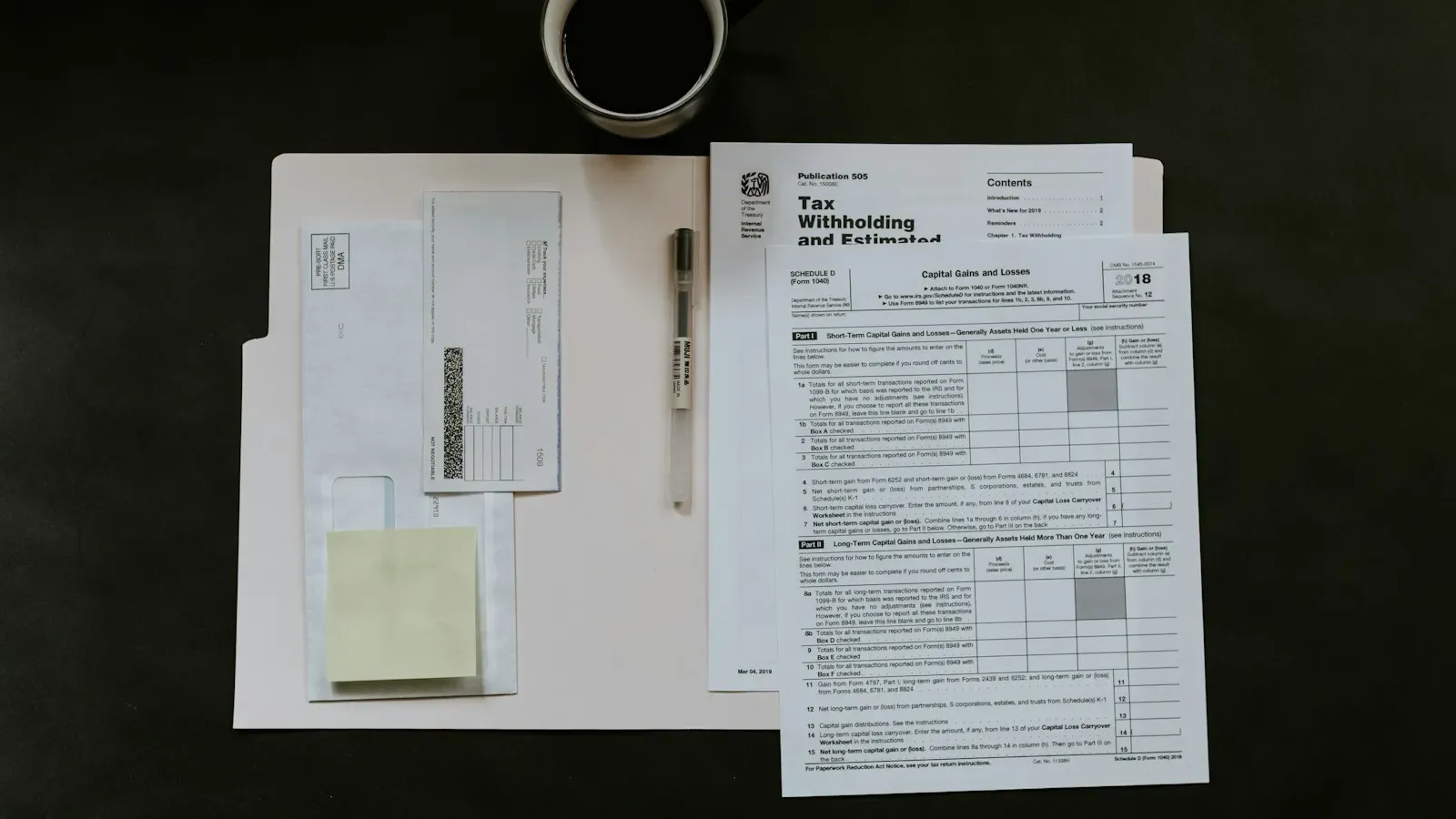
If you drive for DoorDash, Uber, Lyft or Instacart, the IRS treats you as a business owner. You report what the apps pay you on Schedule C, subtract your business expenses (mostly mileage), and pay self-employment tax plus income tax on the profit. Nobody withholds anything, so you set the money aside yourself and usually pay it in quarterly installments.
This guide covers what changed for 2026: higher 1099 thresholds, the new deduction for tips, and a car mileage rate that went up in the middle of the year. Then it works through two drivers’ numbers from start to finish.
Which tax forms the apps send
For payments made in 2026, the IRS raised the Form 1099-NEC threshold to $2,000, up from $600 (Instructions for Forms 1099-MISC and 1099-NEC). A Form 1099-K is required when payments through a payment platform exceed $20,000 and 200 transactions (Instructions for Form 1099-K). Both forms also have new boxes for the tips included in the total.
| App | Forms | Also useful |
|---|---|---|
| DoorDash | 1099-NEC | A separate tip total by email, and an estimate of on-delivery miles |
| Uber | 1099-K for rides and deliveries; 1099-NEC for referrals and promotions | A tax summary with fees and online miles, even without a 1099 |
| Lyft | 1099-K for ride payments; 1099-NEC for bonuses and referrals | An annual summary with fees, tolls and online miles |
| Instacart | Check the Shopper app | Instacart's public shopper site doesn't list its tax forms |
DoorDash
- Forms
- 1099-NEC
- Also useful
- A separate tip total by email, and an estimate of on-delivery miles
Uber
- Forms
- 1099-K for rides and deliveries; 1099-NEC for referrals and promotions
- Also useful
- A tax summary with fees and online miles, even without a 1099
Lyft
- Forms
- 1099-K for ride payments; 1099-NEC for bonuses and referrals
- Also useful
- An annual summary with fees, tolls and online miles
Instacart
- Forms
- Check the Shopper app
- Also useful
- Instacart's public shopper site doesn't list its tax forms
From each company's help pages (DoorDash Help Center, Uber Help, Lyft Help, Instacart Shoppers). Some pages still show the $600 threshold that applied to 2025 payments, and some states require forms at lower amounts. Instacart's public site doesn't list its tax forms.
About these forms:
- No form doesn’t mean no tax. The IRS says you must report gig income even if it isn’t on a 1099-K, 1099-NEC or other information return (Gig economy tax center). The thresholds only decide whether the app sends you a form.
- A 1099-K can show more than you were paid. Lyft says box 1 of its 1099-K is the total passengers paid, including fees and taxes. The fees the app kept are a business expense, so use the app’s annual summary to deduct them and report the right profit.
- Tips are business income too. DoorDash says it reports tip income separately from the 1099 and emails the total by January 31. For 2026, that email doesn’t count for the tips deduction: only tips shown on the 1099 itself do (box 1b of the 1099-NEC, box 1c of the 1099-K).
The tips deduction: does it apply to drivers?
Yes, for most drivers. The law passed in 2025 created a deduction for qualified tips, and the IRS list of tipped occupations includes “platform/app-based rideshare driver” and “app/platform-based delivery person” (IRS tipped occupations). The rules for the self-employed:
- Up to $25,000 a year, for 2025 through 2028 (IRS).
- Capped at the net income of your driving business: net profit minus the deductible half of self-employment tax and contributions to your own retirement plan (Schedule 1-A, 2025 Form 1040 instructions).
- Phases out above $150,000 of modified AGI ($300,000 if married filing jointly): $100 less for each full $1,000 over the threshold.
- You need a valid Social Security number, and married couples must file jointly.
- The tips must be on a 1099. From 2026, a self-employed driver’s tips count only if a Form 1099-K, 1099-NEC or 1099-MISC shows them separately. Tips that aren’t, including cash tips, don’t qualify (T.D. 10044). Uber lets drivers below the 1099 threshold opt in to a form for this reason.
- Tips earned in certain professional service fields don’t qualify (Notice 2025-69). Driving and delivery are on the IRS list of qualifying occupations.
The deduction goes on Form 1040, line 13b, after your adjusted gross income (Form 1040). Your tips stay in your Schedule C profit, so they still pay 15.3% self-employment tax. The deduction also lowers the taxable income that caps your QBI deduction, per the Form 8995 instructions. In the examples below it saves $420 and $560 of income tax. Hair stylists, barbers and nail techs who rent a booth follow the same rules; Booth Rental Taxes covers them. So do streamers and influencers, for tips from viewers; see Content Creator Taxes.
Mileage: two rates in 2026
For most drivers, the car is the largest deduction. The IRS standard mileage rate for 2026 is 72.5 cents a mile for business driving through June 30 and 76 cents from July 1 (IRS mileage rates), so your log needs dates.
- What the rate replaces. If you use the standard rate, you can’t also deduct depreciation, lease payments, repairs, gas, oil, insurance or registration (Publication 463).
- What you can add. Business parking fees and tolls, on top of the rate.
- The first-year rule. To use the standard rate for a car you own, you must choose it in the first year you use the car for business. After that you can switch between methods from year to year. For a leased car, you must use it for the whole lease.
- Actual expenses instead. You deduct the business share of what the car costs, split by business miles over total miles. It can come out ahead with an expensive car or few miles. Business Mileage and Car Expenses compares the two with an example.
The apps’ mileage numbers are a useful starting point, but they measure different things. DoorDash’s estimate covers on-delivery miles. Uber’s tax summary counts miles driven waiting for a trip, driving to the pickup and on the trip itself. Keep your own log as you go, with dates. The mileage deduction calculator splits your miles between the two 2026 rates.

Other expenses you can deduct
A business expense has to be ordinary and necessary: common in your line of work, and helpful and appropriate for it. If something is partly personal, only the business part counts (Publication 334). For drivers, that usually means:
- Your phone, for the business share of the bill.
- Delivery gear, such as insulated bags.
- Business parking and tolls.
- Fees the app kept, if your 1099-K shows the gross fare.
Self-employment tax, quarterly payments and how much to set aside
Your profit pays self-employment tax of 15.3% on 92.35% of it (Social Security and Medicare), per Schedule SE, plus income tax. Self-Employment Tax Explained goes through it. Since nothing is withheld, you generally make quarterly estimated payments if you’ll owe $1,000 or more for the year. If your earnings swing a lot from month to month, see Estimated Taxes on Irregular Income. These are the numbers for two drivers in 2026, both single and using the standard deduction.
Example 1: a full-time rideshare driver
The driver earns $58,000 for the year after the apps’ fees, including $7,000 of tips, which the 1099-K shows separately in box 1c. They drive 15,000 business miles before July 1 and 17,000 after. They also pay $400 of business tolls and parking, and use their phone 60% for work on a $900 phone bill.
- 1$58,000
Earnings after app fees
Includes $7,000 of tips
- 2−$10,875
Mileage, Jan 1 – Jun 30
15,000 × $0.725
- 3−$12,920
Mileage, Jul 1 – Dec 31
17,000 × $0.76
- 4−$400
Business tolls and parking
- 5−$540
Phone, business share
60% of $900
- 6$33,265
Net profit (Schedule C)
- 7$4,700
Self-employment tax
$33,265 × 92.35% = $30,720; × 15.3%
- 8$30,915
Adjusted gross income
$33,265 − $2,350 (half of SE tax)
- 9−$16,100
Standard deduction
- 10−$7,000
Tips deduction
All $7,000 of tips, under the $25,000 cap
- 11−$1,563
QBI deduction
20% of $7,815 of taxable income (the smaller limit)
- 12$625
Federal income tax
$6,252 of taxable income × 10%
- 13$5,325
Total federal tax
$4,700 + $625
My calculation with the 2026 mileage rates, Form 1040-ES rate schedule and $16,100 standard deduction. Without the tips deduction, income tax would be $1,185 and the total $5,885. No state tax. Rounded to the dollar.
Self-employment tax is most of the bill here: $4,700 of the $5,325. The tips deduction and the QBI deduction bring income tax down to $625, but only a lower profit reduces the self-employment tax, which is why every business mile counts.
- Quarterly payments. To be safe from the underpayment penalty, pay at least 90% of this year’s tax, $4,793. Four payments of $1,199 cover it, due April 15, June 15 and September 15, 2026, and January 15, 2027. You’d owe the last $529 when you file. Paying 100% of last year’s tax instead can be less (110% if your 2025 AGI was over $150,000); see Estimated Tax Deadlines for 2026.
- How much to set aside. $5,325 is 16.0% of the profit, or 9.2% of the $58,000 the apps paid out. The gap is mileage: it’s a deduction, not money that leaves your account on each trip, but your gas, insurance and repairs do. Setting aside about 10% of each payout covers the federal tax in this example.
Example 2: a part-time DoorDash driver with a day job
The driver earns $45,000 in W-2 wages, and the withholding on that paycheck is right for the wages alone. In the evenings they earn $14,000 from DoorDash, including $3,500 of tips, which I assume the 1099-NEC shows in box 1b. They drive 2,400 business miles before July 1 and 2,600 after, and pay $100 for parking, $60 for insulated bags and $240 for the business share of their phone.
- 1$14,000
DoorDash earnings
Includes $3,500 of tips
- 2−$1,740
Mileage, Jan 1 – Jun 30
2,400 × $0.725
- 3−$1,976
Mileage, Jul 1 – Dec 31
2,600 × $0.76
- 4−$400
Parking, bags and phone
$100 + $60 + $240
- 5$9,884
Net profit (Schedule C)
- 6$1,397
Self-employment tax
$9,884 × 92.35% = $9,128; × 15.3%
- 7$3,682
Income tax with DoorDash
Taxable income $32,748, after the $3,500 tips deduction and a $1,837 QBI deduction
- 8−$3,220
Income tax on the job alone
Covered by paycheck withholding
- 9$462
Extra income tax from DoorDash
- 10$1,859
Federal tax to set aside
$1,397 + $462
My calculation with the 2026 mileage rates, rate schedule and $16,100 standard deduction. Without the tips deduction, the extra income tax would be $420 higher. No state tax. Rounded to the dollar.
This driver needs to set aside 18.8% of the DoorDash profit, or 13.3% of what DoorDash pays, more than the full-time driver as a share of profit. The day job has already used up the lowest tax brackets, so every DoorDash dollar is taxed at 12% instead of 10%.
They’ll owe more than $1,000 beyond their withholding, so there are two ways to avoid a penalty:
- Raise withholding at the day job. The 2026 Form 1040-ES says you may avoid estimated payments by filing a new Form W-4 with your employer (Form 1040-ES). About $1,859 more over the year covers the DoorDash tax.
- Or pay quarterly. Withholding plus estimates must reach 90% of the year’s total tax ($4,571 of $5,079). With $3,220 withheld, that’s at least $1,351 in estimates. Four payments of $338 cover it, with $507 left to pay at filing.
You can run your own numbers with the Freelance Tax Calculator and quarterly estimated tax calculator. Both have a field for tips. For the method behind the percentages, see How Much Should I Set Aside for Taxes as a Freelancer?
Retirement: a Solo 401(k) for drivers
Because you’re self-employed, you can open a Solo 401(k) or a SEP IRA for your driving income. For the full-time driver above, with $33,265 of profit, a Solo 401(k) allows up to $30,683 for someone under 50: a $24,500 employee deferral plus a $6,183 employer contribution. A SEP IRA would allow only the $6,183. Solo 401(k) vs. SEP IRA compares the two plans.
Before you choose:
- The tax saving is limited. A Traditional contribution lowers income tax, not self-employment tax. This driver’s whole federal income tax is $625, so that’s the most a Traditional contribution could save this year. A Roth contribution, if the plan offers it, gives up nothing today and grows tax-free.
- A day job’s 401(k) shares the limit. The $24,500 employee deferral is per person, across every 401(k) you have. See Can I Have a Solo 401(k) and a 401(k) at Work?