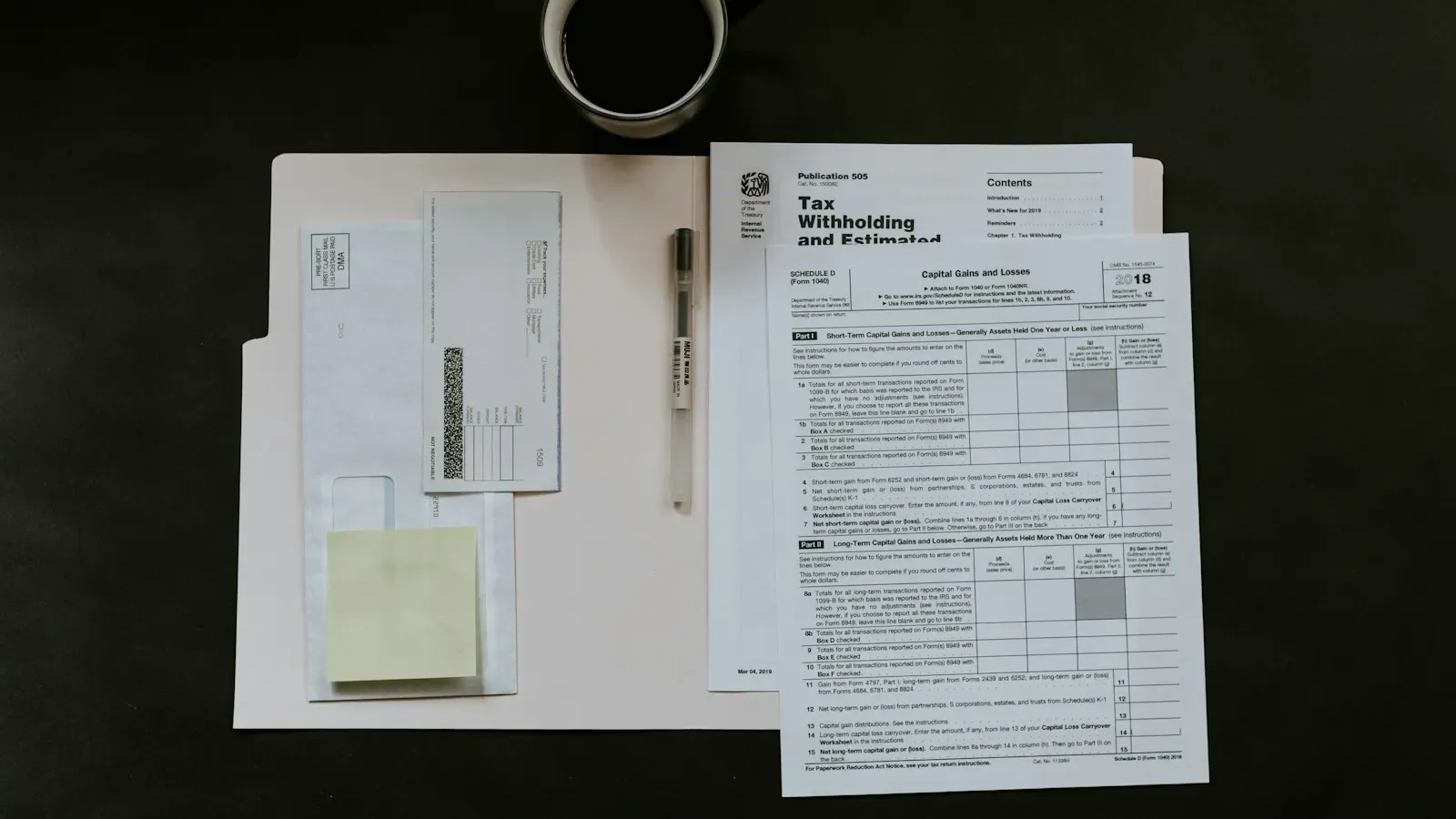
Nobody withholds tax from freelance income, so the IRS expects you to pay it yourself during the year, in four installments. To figure the amount, you estimate your whole year’s federal tax (income tax plus self-employment tax), work out the minimum you need to prepay to avoid a penalty, and divide that by four. The IRS’s own tool for this is the worksheet in the 2026 Form 1040-ES. Below we go through it line by line, with real numbers.
Do you even need to pay estimated tax?
For 2026, you generally must make estimated payments if both of these are true, per the Form 1040-ES instructions:
- You expect to owe at least $1,000 for 2026 after subtracting withholding and refundable credits.
- You expect your withholding and refundable credits to be less than the smaller of 90% of your 2026 tax or 100% of the tax on your 2025 return. That second figure becomes 110% if your 2025 adjusted gross income was over $150,000 ($75,000 if married filing separately in 2026).
There’s one exception: you don’t have to pay 2026 estimated tax if you were a U.S. citizen or resident alien for all of 2025 and had no tax liability for that full year. If you’re a full-time freelancer, you’ll almost always clear the $1,000 threshold. At $80,000 of profit, our example below comes to more than $16,000 of federal tax.
Those percentages are the “safe harbor” rules. They decide how much you must prepay, which isn’t necessarily the same as how much you will owe. We cover them in depth in Estimated Tax Deadlines for 2026 and the Safe Harbor Rule.
Step by step: the 2026 Estimated Tax Worksheet
Here’s how the worksheet runs for a sole proprietor, in plain language. Publication 505 (2026) has the full version (Worksheets 2-1 and 2-3).
Step 1: Figure your self-employment tax first
Self-employment tax comes first, because half of it is a deduction you need before you can find your income. Per the 2026 Self-Employment Tax and Deduction Worksheet in Form 1040-ES:
- Multiply your expected net profit by 92.35%. That’s your net earnings from self-employment.
- Multiply that by 12.4% for Social Security, up to a 2026 maximum of $184,500 of earnings, and by 2.9% for Medicare, with no cap.
- Add the two together to get your self-employment tax. Half of it is deductible.
If the 92.35% step is new to you, Self-Employment Tax Explained goes through where each number comes from.
Step 2: Figure your expected adjusted gross income
Take your expected income and subtract adjustments. For a freelancer, the main one is the deductible half of self-employment tax from Step 1.
Step 3: Subtract your deductions
For 2026, the standard deduction is $16,100 for single filers and married filing separately, $24,150 for head of household, and $32,200 for married filing jointly, per Form 1040-ES. Most sole proprietors can also take the qualified business income (QBI) deduction, up to 20% of their qualified business income. The deduction is capped at 20% of taxable income (minus net capital gain), per the IRS. Your QBI is your business profit reduced by items like the deductible part of self-employment tax. The 2026 Form 1040-ES notes the QBI deduction is now permanent. Below $201,750 of taxable income for single filers ($403,500 married filing jointly), the extra limits based on W-2 wages and business type don’t apply, per Rev. Proc. 2025-32.
Step 4: Apply the 2026 tax rate schedule
Run your taxable income through the 2026 tax rate schedules printed in Form 1040-ES. For a single filer, that’s 10% on the first $12,400 and 12% up to $50,400, with higher rates after that.
Step 5: Add self-employment tax and subtract credits
Add your Step 1 self-employment tax to the income tax, plus any other taxes, and subtract credits. That’s your total estimated tax for 2026.
Step 6: Work out your required annual payment and divide by four
Take the smaller of 90% of your 2026 estimated tax or 100% (or 110%) of your 2025 tax. Subtract any withholding you expect. If the result is zero or less, or your total estimated tax minus withholding is under $1,000, you’re not required to make payments. Otherwise, divide by four. That’s your installment.
Worked example: an $80,000 freelancer
Say you’re a single freelance designer. You expect $80,000 of net profit in 2026, with no other income, no withholding, no credits, and the standard deduction. Your 2025 return showed $12,000 of total tax, on an AGI under $150,000.
- 1$80,000
Expected net profit (Schedule C)
- 2$73,880
Net earnings from self-employment
$80,000 × 92.35%
- 3$11,304
Self-employment tax
$73,880 × 12.4% = $9,161 + $73,880 × 2.9% = $2,143
- 4−$5,652
Deductible half of SE tax
$11,304 × 50%
- 5$74,348
Expected adjusted gross income
$80,000 − $5,652
- 6−$16,100
Standard deduction (single)
- 7−$11,650
QBI deduction
20% × the smaller of $74,348 (QBI) or $58,248 (taxable income before QBI)
- 8$46,598
Taxable income
$74,348 − $16,100 − $11,650
- 9$5,344
Income tax
$1,240 + 12% × ($46,598 − $12,400)
- 10$16,648
Total 2026 estimated tax
$5,344 income tax + $11,304 SE tax
- 11$14,983
90% of 2026 estimated tax
$16,648 × 90%
- 12$12,000
100% of 2025 tax
- 13$12,000
Required annual payment (the smaller)
- 14$3,000
Each quarterly payment
$12,000 ÷ 4
Every step is rounded to the whole dollar, as on the IRS worksheet. Assumes no other income, withholding, credits, retirement contributions or health insurance deduction. Federal only.
So in this example, paying $3,000 a quarter is enough to avoid an underpayment penalty, as long as each payment is on time. But it doesn’t cover the full bill. You’d still owe about $4,648 ($16,648 − $12,000) when you file your 2026 return. If you’d rather owe close to nothing in April, pay one-quarter of the full estimate instead: $16,648 ÷ 4 = $4,162 per payment. Both approaches are legitimate. The first keeps more cash in your hands during the year, and the second avoids a large balance due at filing.
When the payments are due
For 2026, the four installments are due April 15, 2026, June 15, 2026, September 15, 2026, and January 15, 2027. The periods aren’t equal quarters. The second covers only two months and the fourth covers four.
- Payment 1
Due April 15, 2026
Covers Jan 1 – Mar 31 (3 months)
- Payment 2
Due June 15, 2026
Covers Apr 1 – May 31 (2 months)
- Payment 3
Due September 15, 2026
Covers Jun 1 – Aug 31 (3 months)
- Payment 4
Due January 15, 2027
Covers Sep 1 – Dec 31 (4 months)
Source: 2026 Form 1040-ES and IRS Publication 505 (2026). If a due date falls on a weekend or legal holiday, the payment is on time the next business day. You can skip the January payment if you file your full 2026 return by February 1, 2027 and pay the whole balance.
If you started freelancing partway through the year, you don’t pay for periods before you had the income. Publication 505 says your first payment is due for the period in which you first have income subject to estimated tax. If your income changes mid-year, refigure your estimate. Publication 505’s amended estimated tax worksheet has you pay 75% of the new annual amount, minus what you’ve already paid, by the September 15 payment, and 100% by the January payment.
How to pay
The Form 1040-ES instructions list several no-fee electronic options: your IRS Online Account, IRS Direct Pay (straight from a checking or savings account), and EFTPS, which requires enrollment. Card payments are also possible through processors that charge a fee. You can still mail a check with the payment voucher from Form 1040-ES. See the IRS payments page for all the options.
Bottom line
Estimate the year, figure self-employment tax first, apply the 2026 deductions and rate schedule, then compare 90% of this year’s tax against 100% (or 110%) of last year’s. Pay one-quarter of the smaller amount by each due date. Your own numbers will differ from the example: state tax, W-2 wages, retirement contributions and credits all change the result. The worksheet steps stay the same, though. For a quick gut-check before you run them, see How Much Should a Freelancer Set Aside for Taxes?