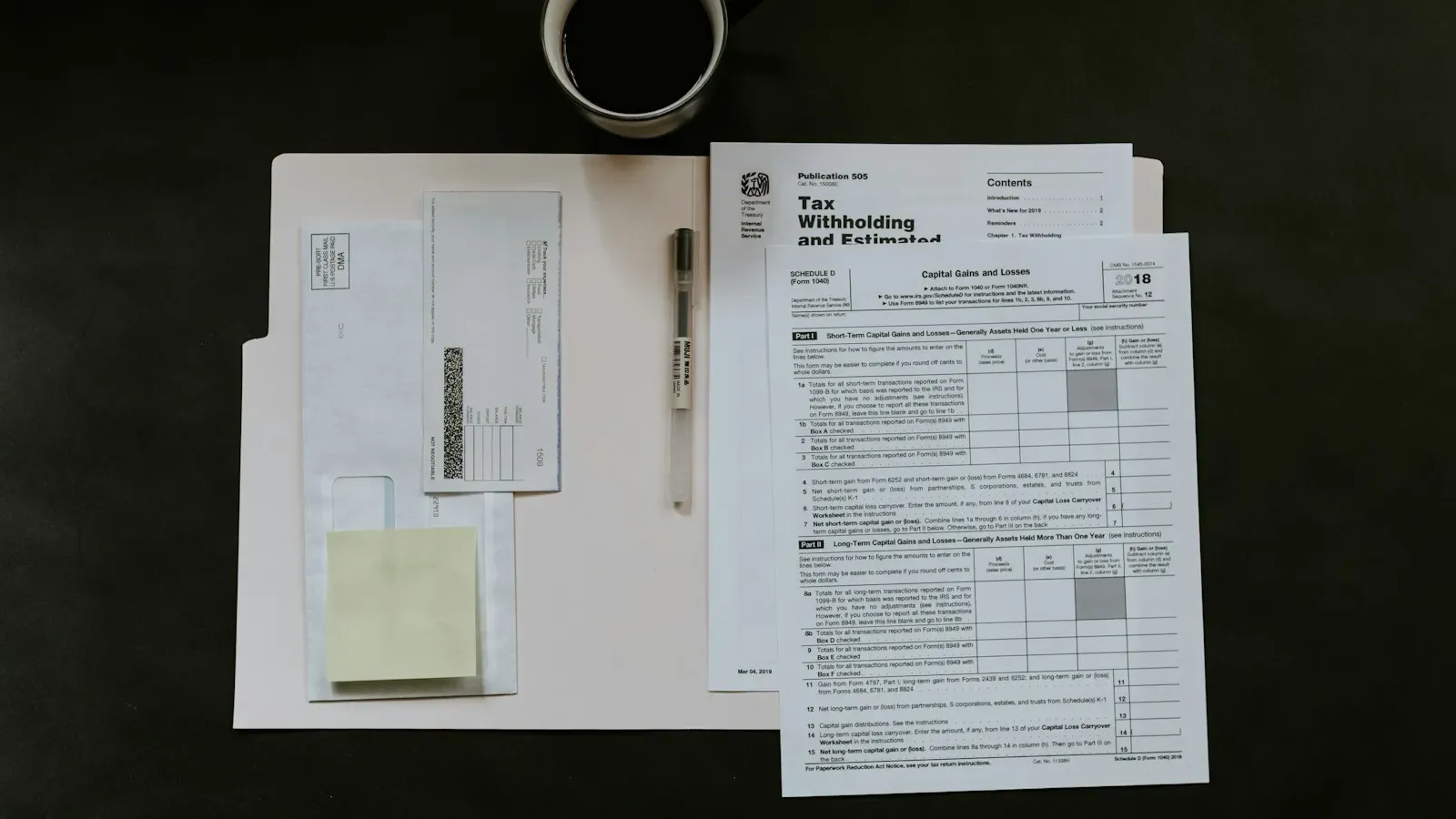
Filing as a freelancer for the first time is mostly a matter of doing things in the right order. You total your business income, subtract your business expenses on Schedule C, work out self-employment tax on Schedule SE, take the adjustments on Schedule 1, apply the QBI deduction, and carry everything to Form 1040. This guide is the map. Each step is a few lines here and a link to the full guide for it. To see your own result as you read, open the freelance tax calculator.
One note on dates. The IRS forms and instructions I quote are the 2025 editions, the latest published, and the line numbers are theirs. The 2026 forms will be out before you file in 2027, so check the line numbers then. The dollar figures in the example are 2026 figures.
The forms you’ll use
| Form | What it does | Key lines (2025 forms) |
|---|---|---|
| Schedule C | Business income minus expenses | Line 1 income, line 28 expenses, line 30 home office, line 31 net profit |
| Schedule SE | Self-employment tax on that profit | Line 2 profit, line 12 tax, line 13 half of it |
| Schedule 1 | Business income in, adjustments out | Line 3 profit, line 15 half of SE tax, line 16 SEP or Solo 401(k), line 17 health insurance, line 13 HSA, line 26 total adjustments |
| Form 8995 | The QBI deduction, up to 20% | Result goes to Form 1040, line 13a |
| Schedule 2 | Adds self-employment tax to your total tax | Line 4 SE tax, line 21 total, to Form 1040 line 23 |
| Form 1040 | Pulls it together and shows what you owe | Line 8, 10, 11a, 12e, 13a, 15, 23, 24, 26, 37 |
| Form 4868 | Optional: extension to file | Due on the original due date |
Schedule C
- What it does
- Business income minus expenses
- Key lines (2025 forms)
- Line 1 income, line 28 expenses, line 30 home office, line 31 net profit
Schedule SE
- What it does
- Self-employment tax on that profit
- Key lines (2025 forms)
- Line 2 profit, line 12 tax, line 13 half of it
Schedule 1
- What it does
- Business income in, adjustments out
- Key lines (2025 forms)
- Line 3 profit, line 15 half of SE tax, line 16 SEP or Solo 401(k), line 17 health insurance, line 13 HSA, line 26 total adjustments
Form 8995
- What it does
- The QBI deduction, up to 20%
- Key lines (2025 forms)
- Result goes to Form 1040, line 13a
Schedule 2
- What it does
- Adds self-employment tax to your total tax
- Key lines (2025 forms)
- Line 4 SE tax, line 21 total, to Form 1040 line 23
Form 1040
- What it does
- Pulls it together and shows what you owe
- Key lines (2025 forms)
- Line 8, 10, 11a, 12e, 13a, 15, 23, 24, 26, 37
Form 4868
- What it does
- Optional: extension to file
- Key lines (2025 forms)
- Due on the original due date
Line numbers are from the 2025 Form 1040, Schedule C, Schedule SE and Schedule 1. Schedule C line 31 feeds Schedule 1 line 3 and Schedule SE line 2; Schedule SE line 12 goes to Schedule 2 line 4 and line 13 to Schedule 1 line 15.
Step by step
1. Gather your income
Collect every 1099-NEC, 1099-K and 1099-MISC, and build your own list of invoices and deposits, because income without a form is still income. The 1099-NEC vs. 1099-K guide covers the thresholds, overlaps and what to do when a form is wrong.
2. Add up your expenses
To count, an expense must be ordinary and necessary for your business, per Publication 334. Sort your business costs by Schedule C line: advertising, contract labor, software, equipment and so on. The Schedule C deductions guide goes line by line, including meals at 50%, year-end equipment and what records to keep. Two big ones have their own guides: the home office deduction and business mileage.
3. Fill in Schedule C
Gross receipts go on line 1, expenses on lines 8 through 27b, and the total on line 28. The home office goes on line 30, separately. Net profit or loss is line 31. A profit goes on Schedule 1 line 3 and Schedule SE line 2, per the form.
4. Figure self-employment tax on Schedule SE
You must file Schedule SE if line 4c is $400 or more. The form takes your profit, multiplies it by 92.35%, and applies 12.4% for Social Security up to the annual limit and 2.9% for Medicare. Line 12 is the tax, and line 13 is half of it, which you deduct. The self-employment tax guide explains why it isn’t 15.3% of all your profit.
5. Take your adjustments on Schedule 1
Schedule 1 collects the deductions that aren’t Schedule C expenses: half of SE tax (line 15), your own SEP, SIMPLE or Solo 401(k) contribution (line 16), self-employed health insurance (line 17) and an HSA (line 13). Line 26 totals them and goes to Form 1040 line 10. The guides: health insurance deduction, ACA Marketplace coverage, Solo 401(k) vs. SEP IRA and the HSA guide.
6. Claim the QBI deduction
Form 8995 figures a deduction of up to 20% of your qualified business income, limited to 20% of your taxable income before the deduction. The Form 8995 instructions say QBI is reduced by the deductible part of self-employment tax, the self-employed health insurance deduction and contributions to retirement plans. The QBI guide has the details.
7. Complete Form 1040
Your profit comes in on line 8 through Schedule 1, adjustments come off on line 10, and line 11a is your adjusted gross income. The standard deduction is line 12e, QBI is line 13a, and line 15 is taxable income. Income tax is line 16, and self-employment tax joins it on line 23 through Schedule 2. Line 24 is your total tax. Subtract payments (line 26 for estimated tax, line 33 for the total) and line 37 is what you owe.
8. Pay, and set up next year
Pay what’s due by the due date, and start making quarterly payments for the new year. Quarterly Estimated Taxes shows how, and Estimated Tax Deadlines covers the dates and safe harbors. How Much Should I Set Aside for Taxes as a Freelancer? helps with the percentage. If you haven’t picked a business structure, LLC vs. sole proprietorship is worth five minutes.
A full example at $80,000
This is the same freelancer as in the deductions guide: single, no other income, no dependents, $80,000 of revenue and $15,450 of expenses, of which $1,000 is the home office. State tax isn’t included.
| Form and line | Amount |
|---|---|
| Schedule C, line 1, gross receipts | $80,000 |
| Schedule C, line 28, expenses before home office | $14,450 |
| Schedule C, line 30, home office | $1,000 |
| Schedule C, line 31, net profit | $64,550 |
| Schedule SE, line 12, self-employment tax | $9,121 |
| Schedule SE, line 13, half of it (to Schedule 1, line 15) | $4,561 |
| Form 1040, line 11a, adjusted gross income | $59,989 |
| Form 1040, line 12e, standard deduction (2026) | $16,100 |
| Form 1040, line 13a, QBI deduction | $8,778 |
| Form 1040, line 15, taxable income | $35,111 |
| Form 1040, line 16, income tax | $3,965 |
| Form 1040, line 23, self-employment tax | $9,121 |
| Form 1040, line 24, total federal tax | $13,086 |
Schedule C, line 1, gross receipts
- Amount
- $80,000
Schedule C, line 28, expenses before home office
- Amount
- $14,450
Schedule C, line 30, home office
- Amount
- $1,000
Schedule C, line 31, net profit
- Amount
- $64,550
Schedule SE, line 12, self-employment tax
- Amount
- $9,121
Schedule SE, line 13, half of it (to Schedule 1, line 15)
- Amount
- $4,561
Form 1040, line 11a, adjusted gross income
- Amount
- $59,989
Form 1040, line 12e, standard deduction (2026)
- Amount
- $16,100
Form 1040, line 13a, QBI deduction
- Amount
- $8,778
Form 1040, line 15, taxable income
- Amount
- $35,111
Form 1040, line 16, income tax
- Amount
- $3,965
Form 1040, line 23, self-employment tax
- Amount
- $9,121
Form 1040, line 24, total federal tax
- Amount
- $13,086
Same inputs and function as our freelance tax calculator: single filer, no other income, 2026 rates. Line numbers are from the 2025 forms. The QBI figure is 20% of $43,889, the taxable income before the deduction, because that is smaller than 20% of the $59,989 of qualified business income.
The profit counts twice, first as income and then as the base for self-employment tax. The $13,086 is about 20% of the profit, which is why a quarter of it, $3,272, is a reasonable quarterly payment.
Now suppose the same freelancer also pays $4,800 of health insurance premiums and puts $6,000 into a Solo 401(k). They go on Schedule 1, lines 17 and 16.
| Without | With | |
|---|---|---|
| Schedule 1, line 26, adjustments | $4,561 | $15,361 |
| Form 1040, line 11a, AGI | $59,989 | $49,189 |
| Form 1040, line 13a, QBI deduction | $8,778 | $6,618 |
| Form 1040, line 15, taxable income | $35,111 | $26,471 |
| Income tax | $3,965 | $2,929 |
| Self-employment tax | $9,121 | $9,121 |
| Total federal tax | $13,086 | $12,050 |
Schedule 1, line 26, adjustments
- Without
- $4,561
- With
- $15,361
Form 1040, line 11a, AGI
- Without
- $59,989
- With
- $49,189
Form 1040, line 13a, QBI deduction
- Without
- $8,778
- With
- $6,618
Form 1040, line 15, taxable income
- Without
- $35,111
- With
- $26,471
Income tax
- Without
- $3,965
- With
- $2,929
Self-employment tax
- Without
- $9,121
- With
- $9,121
Total federal tax
- Without
- $13,086
- With
- $12,050
Each column is a separate run of the same calculator function. The self-employment tax doesn't change because both adjustments come after it.
The two adjustments cut the bill by $1,036, all of it income tax. Self-employment tax stays at $9,121, because health insurance and retirement contributions come off after it’s figured. The QBI deduction falls by $2,160 since QBI is reduced by both.

When to file, and what an extension does
Returns for 2026 are due April 15, 2027, the usual date, and the 2026 payments you owe are due then too. Form 4868 gives an automatic 6 months to file, to October 15, 2027, if you file it by the original due date. The Form 1040 instructions are clear that this doesn’t extend the time to pay. Interest runs on unpaid tax from the original due date, and penalties can apply.
| Penalty | Usual amount |
|---|---|
| Late filing | 5% of the tax due for each month or part of a month, up to 25% |
| Late filing, more than 60 days late | Minimum penalty of $525 or the tax you owe, whichever is smaller (2025 returns) |
| Late payment | ½ of 1% of the unpaid tax for each month or part of a month, up to 25% |
Late filing
- Usual amount
- 5% of the tax due for each month or part of a month, up to 25%
Late filing, more than 60 days late
- Usual amount
- Minimum penalty of $525 or the tax you owe, whichever is smaller (2025 returns)
Late payment
- Usual amount
- ½ of 1% of the unpaid tax for each month or part of a month, up to 25%
From the penalties section of the Instructions for Form 1040 (2025). Interest is charged on top, and the dollar minimum is adjusted for later years.
So if you can’t finish, file the extension and pay your best estimate with it. If you can’t pay it all, the instructions say you can still file and ask for an installment agreement or an extension of time to pay, though interest and the late payment penalty can still apply.
Your 2027 estimated payments follow the same four-date pattern as the 2026 ones, starting in April. The 2027 Form 1040-ES will list the exact dates. For the 2026 year, the January 15, 2027 payment is the fourth, and Form 1040-ES says you can skip it if you file your return by February 1, 2027 and pay the whole balance with it.
First-year mistakes
- Treating the 1099s as your income. Build your total from your own records, then reconcile it to the forms.
- Forgetting self-employment tax. It applies from $400 of net earnings, and it’s on top of income tax.
- Skipping estimated payments. Without withholding, the whole bill lands in April, and the form asks about estimated payments on line 26.
- Mixing personal and business money. A separate account and card make every later step easier.
- Counting on the extension to pay. It’s a file extension only.
- Missing the adjustments. Health insurance, retirement and HSA contributions are on Schedule 1, not Schedule C, and don’t reduce self-employment tax.
- Ignoring your state. Most states with an income tax have their own return and estimated payments. This guide covers federal tax only.
Checklist
- Every 1099 and your own income list, reconciled.
- Expenses sorted by Schedule C line, with receipts and a mileage log.
- Schedule C and Schedule SE completed.
- Health insurance, retirement and HSA amounts for Schedule 1.
- QBI deduction figured on Form 8995.
- Form 1040 checked against your estimated payments.
- Balance paid by April 15, or Form 4868 filed and a payment sent with it.
- First estimated payment of the new year in the calendar.
How we got these figures
The form flow and line numbers come from the 2025 Form 1040, Schedule C, Schedule SE and Schedule 1, and their instructions. The $400 rule is from the Schedule SE and Form 1040 instructions, the extension and penalties from the Form 1040 instructions and Form 4868, the $1,000 estimated tax test and the 2026 payment dates from the 2026 Form 1040-ES, and the QBI rules from the Instructions for Form 8995, all of which we opened on October 10, 2026. The 2027 due dates are the ordinary April 15 and October 15 dates, as in our SEP IRA guide. The example is our own arithmetic, run through the same functions as our freelance tax calculator, once for each column, with a single filer, no other income and no state tax. For how we choose and check sources, see How We Research.
This is general information, not tax advice for your situation. A tax professional can confirm what applies to you before you file.