
Short answer: by December 31, 2026, elect any Solo 401(k) deferral, place equipment in service, and pay or receive what belongs to 2026. A SEP IRA, an HSA and a Roth IRA follow later deadlines, and the fourth estimated payment is due January 15, 2027, unless you file by February 1, 2027 and pay the whole balance.
For a self-employed person on the cash method, the calendar year works like a gate. A few things must be done before it closes: a Solo 401(k) deferral has to be elected, equipment has to be ready for use, and a bill has to be paid for the cost to belong to 2026. Others, like opening a SEP IRA or funding an HSA, can wait into 2027. The mistake is treating everything as a December emergency, or missing the few items that really are.
This guide sorts them. Two examples use a hypothetical freelancer with $90,000 of profit, run through our 2026 federal tax estimate. The dates and rules come from IRS sources.
What closes on December 31 and what doesn’t
| Item | Deadline for 2026 | Source |
|---|---|---|
| Elect Solo 401(k) employee deferrals | December 31, 2026 | Publication 560 |
| Place business equipment in service for a 2026 deduction | December 31, 2026 | Publication 946 |
| Pay a 2026 business expense | December 31, 2026 | Publication 334 |
| Receive client income for 2026 (a valid check counts) | December 31, 2026 | Publication 334 |
| Fourth estimated tax payment | January 15, 2027, or file by February 1, 2027 and pay in full | 2026 Form 1040-ES |
| Open a SEP IRA and deposit the contribution | Return due date, including extensions | IRS SEP FAQs |
| Fund an HSA or a Roth IRA | Due date of your 2026 return, not counting extensions | Form 8889 instructions and Publication 590-A |
Elect Solo 401(k) employee deferrals
- Deadline for 2026
- December 31, 2026
- Source
- Publication 560
Place business equipment in service for a 2026 deduction
- Deadline for 2026
- December 31, 2026
- Source
- Publication 946
Pay a 2026 business expense
- Deadline for 2026
- December 31, 2026
- Source
- Publication 334
Receive client income for 2026 (a valid check counts)
- Deadline for 2026
- December 31, 2026
- Source
- Publication 334
Fourth estimated tax payment
- Deadline for 2026
- January 15, 2027, or file by February 1, 2027 and pay in full
- Source
- 2026 Form 1040-ES
Open a SEP IRA and deposit the contribution
- Deadline for 2026
- Return due date, including extensions
- Source
- IRS SEP FAQs
Fund an HSA or a Roth IRA
- Deadline for 2026
- Due date of your 2026 return, not counting extensions
- Source
- Form 8889 instructions and Publication 590-A
Dates from the IRS sources named in each row. For 2025 contributions the IRS gives April 15, 2026 as the unextended filing deadline for most people. The IRS pages we opened state filing dates for 2025 returns, so we do not give a calendar date for the 2026 return.
The first four rows are the real year-end items, and the next sections take them in turn.
Elect your Solo 401(k) deferral by December 31
The IRS says the owner of a one-participant 401(k) wears two hats, employee and employer, and can contribute in both capacities. The two parts follow different timing rules. Publication 560 says an owner-employee’s deferrals must be elected by the end of the tax year and can then be made by the tax return filing deadline, including extensions. The election is the year-end item, and the money can follow later.
The 2026 deferral limit is $24,500. The IRS says participants who are 50 or older can generally contribute up to $32,500 each year starting in 2026, which includes the $8,000 catch-up. The overall limit for a defined contribution plan is $72,000 in 2026. Our Solo 401(k) limits guide shows how the employer part is calculated for a sole proprietor. A lower-income freelancer may also qualify for the Saver’s Credit on that contribution, and our Saver’s Credit guide explains the income limits.
If you don’t have a plan yet, the IRS issue snapshot says a plan generally has to exist before compensation can be deferred. It makes one exception: an individual who owns the entire interest in an unincorporated business, and is its only employee, can adopt a new 401(k) plan after year-end and, for the first year only, elect to defer prior-year net earnings as late as the due date of the tax return, without regard to extensions. Opening the plan in December is simpler. Our step-by-step guide to opening a Solo 401(k) covers the paperwork, and the Roth vs. Traditional comparison helps you choose the type of deferral.
What a $10,000 deferral does to the tax bill
Take a hypothetical single freelancer with $90,000 of net profit and no other income. Without any retirement contribution, our 2026 estimate gives $6,599 of federal income tax and $12,716 of self-employment tax. Electing a $10,000 Traditional deferral lowers the income tax to $5,276, a saving of $1,323. The self-employment tax stays at $12,716, because a Solo 401(k) deferral doesn’t reduce it, which our guide on that question explains. The $10,000 stays in your account, and the tax saved means it costs $8,677 out of pocket this year.
The estimate assumes a single filer, the standard deduction, the QBI deduction applied, no state tax and no credits. A Roth deferral is subject to federal income tax now, so it would not lower the 2026 tax.
SEP IRA: no December rush
The IRS says you can set up a SEP plan for a year as late as the due date, including extensions, of your business’s income tax return for that year, and that you must deposit contributions by that same date. Our SEP IRA deadline guide walks through the dates, and the SEP IRA guide covers the limits.
Equipment: placed in service by December 31
Publication 946 says property is placed in service when it is ready and available for a specific use, even if you are not using it yet. Its example is a machine delivered last year but not installed and operational until this year, which counts as placed in service this year. A laptop that arrives on December 30 and is set up for work is placed in service in 2026. A laptop still in its box isn’t ready for use.
Under section 179 you can elect to deduct a limited amount of the cost of certain depreciable property in the year you place it in service. For tax years beginning in 2026, Publication 946 puts the maximum at $2,560,000, reduced once the cost of qualifying property placed in service in the year passes $4,090,000. Three other rules matter more for most freelancers:
- The property must be used more than 50% for business. If you use it for both, you multiply the cost by the percentage of business use.
- The deduction is limited to the taxable income from the active conduct of any trade or business during the year, and any cost you can’t deduct because of that limit carries to the next year.
- You make the election on Form 4562, filed with the original return for the year the property was placed in service, or with a timely amended return.
What a $2,400 laptop does to the tax bill
Say the same hypothetical freelancer, with $90,000 of profit, buys a $2,400 laptop used entirely for work and places it in service on December 30. If they elect to expense it, our 2026 estimate shows $731 less federal tax: $339 of self-employment tax and $392 of income tax. Buying the same laptop on January 2 moves that deduction to the 2027 return, so it is a timing difference. Spending $2,400 to save $731 only makes sense if you were going to buy it anyway. Our deductions guide covers the categories you can claim.
Expenses: pay by December 31, but watch prepayments
Under the cash method, Publication 334 says you generally deduct expenses in the tax year in which you pay them. A software bill or a contractor invoice paid on December 29 belongs to 2026.
Prepayment has its own rules. Publication 334 says you may not be able to deduct an expense paid in advance, and that you can deduct it only in the year to which it applies. Its example is a $1,000 business insurance policy paid in 2025 that takes effect July 1 for one year: $500 is deductible in 2025 and $500 in 2026.
A second rule can change the result for short prepayments. Treasury Regulation 1.263(a)-4(f) says a taxpayer is not required to capitalize an amount paid to create a right or benefit that does not extend beyond the earlier of 12 months after the first date the taxpayer realizes it, or the end of the taxable year following the year of payment. Publication 535 (2022), the last edition before the IRS discontinued it, says a cash-method taxpayer whose advance payment qualifies can generally deduct it when paid. Its example is a 12-month lease signed on December 1, 2022, starting January 1, 2023, with all 12 months paid at once: the entire payment is deductible in 2022.
The regulation sets conditions. It does not apply to a right of indefinite duration, the duration includes a renewal period when renewal is reasonably expected, and a taxpayer can elect to capitalize instead. Publication 535 describes the rule for prepaid expenses that create an intangible asset, which does not cover equipment. Publication 334’s insurance example and the 12-month rule give different results for a similar payment, and we did not find IRS text that reconciles them, so confirm any large prepayment with a tax professional.
Year-end is also the time to complete your mileage log. The 2026 business standard mileage rate was 72.5 cents per mile from January 1 through June 30 and 76 cents from July 1 through December 31, and our mileage guide explains what to record.
Income: a check in hand counts
Publication 334 says to include in gross income all items you receive, or constructively receive, during the tax year. Receipt of a valid check by the end of the year is constructive receipt in that year, even if you can’t cash or deposit it until the following year. Its example is a $500 check received on December 30 and deposited on January 3, which counts in the earlier year. The publication also says you can’t hold checks or postpone taking possession of similar property from one tax year to another to avoid paying tax on the income.
The January 15 payment, or file by February 1
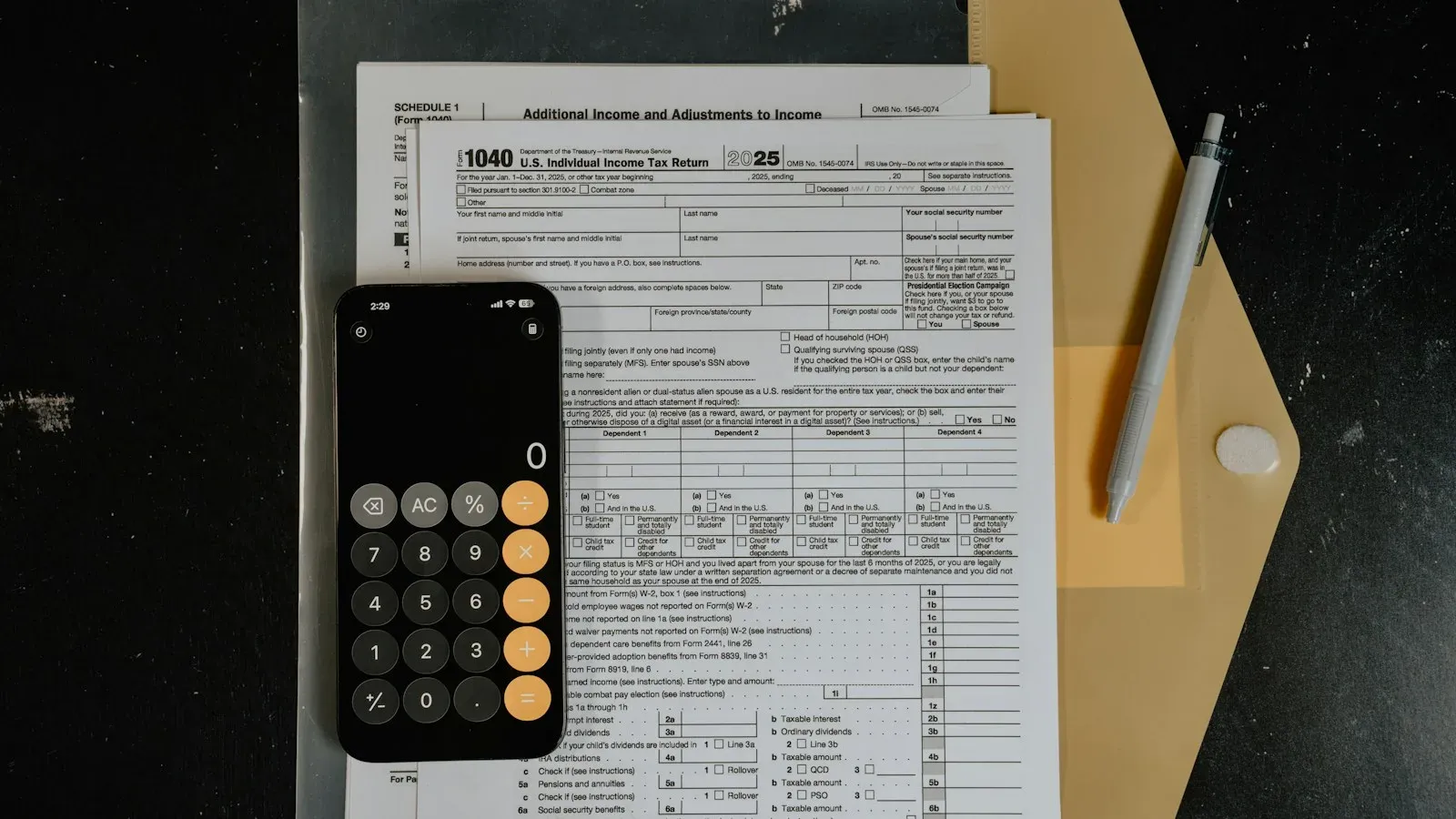
The 2026 Form 1040-ES lists the four payment dates as April 15, June 15, September 15 and January 15, 2027. You don’t have to make the January payment if you file your 2026 return by February 1, 2027 and pay the entire balance due with it. So you can make the fourth payment by January 15, or file early and pay everything with the return. The second option needs your income records and your Solo 401(k) or SEP decisions settled in January. If you pay on January 15 and aren’t sure of the amount, our estimated tax deadlines guide explains the safe harbor figures, the annualized method guide helps when your income came late in the year, and the quarterly estimated tax calculator gives a starting figure.
What can wait until spring
Several accounts people link with year-end have later deadlines:
- HSA. The 2025 Instructions for Form 8889 count contributions for 2025 made by the unextended deadline for filing the 2025 return, April 15, 2026, and Publication 969 (2025) says you can contribute for 2025 through April 15, 2026. The 2026 limit is $4,400 for self-only coverage and $8,750 for family coverage, per IRS Notice 2026-5. Our HSA guide covers eligibility.
- Roth IRA. Publication 590-A says you can contribute to a Roth IRA for a year at any time during the year or by the due date of your return for that year, not including extensions. For 2025 contributions it says most people have until April 15, 2026.
- SEP IRA. Through the return due date including extensions, as above.
A short plan for December
- Run your estimated profit for the year with the self-employment tax calculator and compare it with what you expect to owe.
- Decide whether to elect a Solo 401(k) deferral, and file the election before December 31.
- Buy and set up only the equipment you were going to buy anyway, and keep the date it was ready for use.
- Pay the 2026 expenses you owe, and ask your preparer before prepaying next year’s.
- Complete the mileage log, gather your receipts, and total everything you received, including payments with no form. Our guide on side income and 1099s explains why a missing form doesn’t change what you report.
- If you pay contractors, collect their W-9s. The IRS says the reporting threshold for certain payments increased to $2,000 for tax years beginning after 2025, which our 1099-NEC vs. 1099-K guide explains.
- Choose between paying on January 15 and filing by February 1.
How we got these figures
The Solo 401(k) timing is from Publication 560 (2025) and the IRS issue snapshot, and the 2026 limits from IR-2025-111, Notice 2025-67 and Notice 2026-5. The SEP timing is from the IRS SEP FAQs. The placed-in-service, section 179 and business-use rules are from Publication 946 (2025) and the 2025 Instructions for Form 4562. The cash-method rules for income, checks and general prepayments are from Publication 334 (2025), and the 12-month rule from 26 CFR 1.263(a)-4(f) and Publication 535 (2022). The January 15 and February 1 dates are from the 2026 Form 1040-ES, the $2,000 reporting threshold from the Instructions for Forms 1099-MISC and 1099-NEC, the mileage rates from the IRS standard mileage rates page, and the HSA and Roth IRA windows from the 2025 Instructions for Form 8889, Publication 969 and Publication 590-A. We opened the sources on October 19, 2026.
The $90,000 profit, the $10,000 deferral and the $2,400 laptop are hypothetical. Both results come from our 2026 federal tax estimate for a single filer with the standard deduction, the QBI deduction applied and no state tax or credits, and each one is run on its own against the same $90,000 profit. They illustrate how the rules work and don’t predict your return.
Note
This is general information, not tax advice for your situation. Whether equipment qualifies, how a plan document handles an election and which deadline applies to you depend on the facts, so confirm them with a tax professional or your plan provider before December 31.